
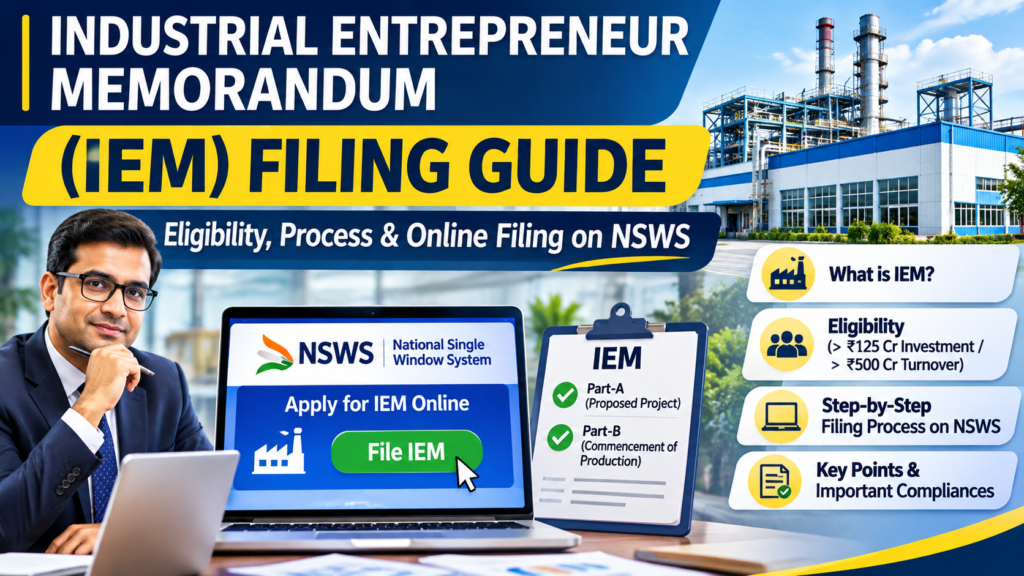
Starting or expanding a manufacturing business in India involves several regulatory requirements, registrations and statutory compliances. One such important filing for eligible large-scale manufacturing enterprises is the Industrial Entrepreneur Memorandum (IEM).
The Government of India has introduced IEM as an information-based filing for industrial undertakings operating in sectors that do not require compulsory industrial licensing. The filing is now available through the National Single Window System (NSWS), making the process more accessible to entrepreneurs and investors.
Let us understand what IEM is, who is eligible to file it and how the process works.
1. What Is an Industrial Entrepreneur Memorandum (IEM)?
An Industrial Entrepreneur Memorandum (IEM) is an information filing submitted by eligible industrial undertakings to the Department for Promotion of Industry and Internal Trade (DPIIT) https://dpiit.gov.in, Ministry of Commerce and Industry, Government of India.
It is generally applicable to large-scale manufacturing enterprises operating in sectors that are not subject to compulsory industrial licensing under the Industries (Development and Regulation) Act, 1951.
The purpose of IEM is to provide the Government with information regarding the proposed industrial undertaking, its manufacturing activities, investment, production capacity and other relevant particulars.
Important: IEM is an informational filing and its acknowledgement should not be treated as an industrial licence, statutory approval or permission to commence business.
2. Which Industries Are Eligible to File IEM?
IEM is intended for eligible large-scale manufacturing enterprises operating in sectors that do not require compulsory industrial licensing.
As per the revised eligibility criteria applicable from 1 April 2025, an enterprise must meet either of the following thresholds:
- Investment in plant and machinery/equipment exceeding ₹125 crore; or
- Annual turnover exceeding ₹500 crore.
These revised thresholds were notified by DPIIT following changes in the MSME classification criteria.
The applicable industrial licensing requirements and eligibility conditions should always be examined before filing.
3. Is IEM Mandatory for Every Manufacturing Business?
No. IEM is not applicable to every manufacturing business.
It is intended for eligible industrial undertakings meeting the prescribed criteria and operating in sectors that do not require compulsory industrial licensing.
Small and medium manufacturing enterprises falling below the prescribed thresholds should not assume that IEM is mandatory merely because they are engaged in manufacturing.
Similarly, businesses operating in sectors requiring compulsory industrial licensing must examine the applicable licensing requirements separately.
4. What Is the Difference Between IEM Part-A and Part-B?
The IEM filing process involves two important stages:
IEM Part-A – Proposed Industrial Activity
Part-A relates to the proposed establishment of an industrial undertaking. It contains information such as:
- Name and details of the applicant entity.
- Location of the proposed manufacturing unit.
- Details of products to be manufactured.
- Relevant National Industrial Classification (NIC) code.
- Proposed investment.
- Proposed production capacity.
- Employment details.
- Expected commencement of commercial production.
Part-A is filed before commencement of commercial production.
IEM Part-B – Commencement of Commercial Production
After commencement of commercial production, the industrial undertaking is required to submit Part-B through the prescribed online process.
It provides information regarding the commencement and implementation of the industrial project. The relevant Part-A acknowledgement is required for this filing.
Both stages are available through the NSWS portal.
5. How Can an Applicant File IEM Through the NSWS Portal?
The Government has migrated IEM services from the earlier G2B portal to the National Single Window System.
The general filing process is as follows:
- Visit the official NSWS portal https://www.nsws.gov.in.
- Register and create a business profile.
- Select Industrial Entrepreneur Memorandum (IEM) under Central Approvals.
- Choose the relevant filing, such as Part-A.
- Enter the prescribed entity and project-related information.
- Provide the required details and supporting documents.
- Complete the prescribed online payment, wherever applicable.
- Submit the application and download the acknowledgement available through the dashboard.
Applicants should ensure that the entity details, manufacturing location, NIC code, investment figures and product descriptions are accurate before submission.
6. Does IEM Acknowledgement Mean That the Manufacturing Unit Has Received All Government Approvals?
No. This is one of the most important points to understand.
An IEM acknowledgement is not a substitute for other statutory registrations, licences or permissions.
Depending upon the nature, location and activities of the manufacturing unit, separate approvals may be required, such as:
- Consent to Establish and Consent to Operate from the State Pollution Control Board.
- Factory licence, wherever applicable.
- Fire safety approvals.
- Environmental clearance, wherever applicable.
- Other applicable local and state-level registrations and permissions.
Therefore, obtaining an IEM acknowledgement does not automatically authorise an enterprise to commence manufacturing operations without fulfilling other applicable legal requirements.
7. What Is the Difference Between IEM and an Industrial Licence?
IEM and an Industrial Licence serve different purposes.
An IEM is an information-based filing for eligible industrial undertakings operating in sectors that do not require compulsory industrial licensing.
An Industrial Licence, on the other hand, is a formal government licence required for industrial activities covered by compulsory licensing provisions.
Therefore, an entrepreneur must first identify whether the proposed manufacturing activity falls under a delicensed or compulsory licensing category before deciding which regulatory process applies.
8. Why Is Correct IEM Filing Important for an Industrial Enterprise?
Correct filing of IEM helps maintain an appropriate government record of the industrial undertaking and its manufacturing activities.
It is particularly important to ensure that the information relating to the applicant entity, manufacturing location, products, investment and production capacity is correctly reported. For larger industrial expansion and funding, review our project financing guide https://capankajpoddar.com/project-financing-guide/
Any subsequent changes in the relevant particulars should also be examined to determine whether an amendment to the IEM record is required.
Frequently Asked Questions (FAQs)
Q1. Is IEM a licence issued by the Government?
No. IEM is an information-based filing. Its acknowledgement is not an industrial licence or statutory clearance.
Q2. Can an LLP file IEM?
An LLP engaged in eligible manufacturing activities may file IEM, subject to the prescribed eligibility conditions.
Q3. Where is IEM filed currently?
New IEM applications and related services are available through the National Single Window System (NSWS).
Q4. When should IEM Part-B be filed?
Part-B is filed after commencement of commercial production.
Q5. Does IEM replace factory or pollution control approvals?
No. All other applicable statutory approvals must be obtained separately.
Conclusion
Industrial Entrepreneur Memorandum is an important regulatory filing for eligible large-scale manufacturing enterprises in India. It provides the Government with information about industrial investment and manufacturing activities in sectors that do not require compulsory industrial licensing.
Understanding the eligibility criteria, selecting the correct NIC code, providing accurate project details and completing both applicable filing stages are important for maintaining proper industrial records.
Before establishing or expanding a manufacturing unit, entrepreneurs should carefully examine the applicable IEM requirements along with other central and state-level statutory approvals.
Disclaimer: This article is intended for general educational and informational purposes. Eligibility, filing requirements and applicable statutory approvals should be verified with reference to the latest government notifications, guidelines and applicable laws.

CA PANKAJ PODDAR – Financial Consultant & Industrial Project Advisor